

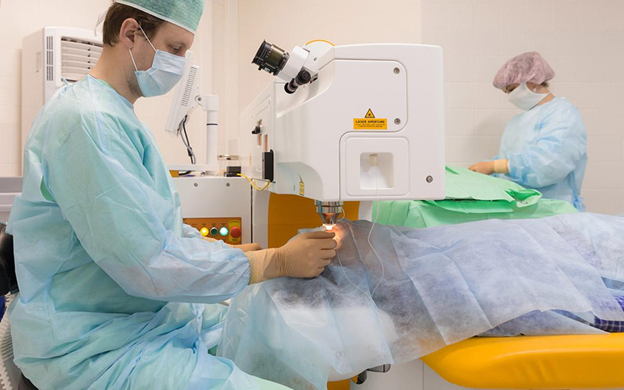
Modern laser systems provide more accurate, predictable, and safer vision correction than ever before.
LASIK has been performed for decades, but the procedure patients experience today is fundamentally different from what early adopters encountered in the 1990s and early 2000s. While the goal remains the same, to correct vision by reshaping the cornea, the technology used to achieve that goal has advanced dramatically.
Modern LASIK is faster, gentler, more precise, and significantly safer than previous generations of laser eye surgery. Complication rates have fallen, visual outcomes have improved, and customization has reached a level that allows surgeons to tailor treatment to the unique structure of each individual eye.
At Anaheim Eye Institute, these technological advances are not viewed as optional upgrades. They are the foundation of how vision correction is performed today, ensuring patients receive results that are not only clear but also stable and comfortable for years to come.
From mechanical blades to bladeless precision
One of the most significant improvements in LASIK technology is the elimination of mechanical microkeratomes, which were the blades previously used to create the corneal flap.
Today, femtosecond lasers perform this step with extraordinary accuracy. These lasers create flaps of uniform thickness and depth, customized to each patient’s corneal anatomy. This precision reduces the risk of irregular flaps, improves healing, and enhances overall safety.
“Bladeless LASIK transformed the procedure from good to exceptional.”
The consistency provided by laser-created flaps allows surgeons to focus more fully on the vision correction itself, knowing that the foundation of the procedure is highly reliable.
Wavefront-guided customization changes everything
Early LASIK treatments were based largely on glasses prescriptions. Modern LASIK goes far beyond that.
Wavefront technology measures how light actually travels through the eye, identifying microscopic imperfections known as higher-order aberrations. These tiny distortions affect contrast sensitivity, night vision, glare, and visual sharpness, even when standard vision tests appear normal.
Using this data, surgeons can design a customized treatment pattern that corrects both common refractive errors and subtle optical flaws unique to the patient.
The result is not just 20/20 vision, but vision that often feels sharper, cleaner, and more natural than what patients experienced with glasses or contacts.
At Anaheim Eye Institute, wavefront-guided LASIK is a core component of achieving premium outcomes.
Eye-tracking systems that move faster than human reflexes
During LASIK, even the smallest eye movement matters. Blinking, breathing, and natural reflexes can cause the eye to shift slightly.
Modern laser systems include high-speed eye trackers that monitor eye position thousands of times per second. If the eye moves, the laser automatically adjusts in real time or pauses entirely.
This ensures the laser energy is delivered exactly where planned, protecting surrounding tissue and maintaining precise correction.
“Today’s LASIK lasers respond faster than the human nervous system.”
This technology dramatically reduces the margin for error and increases consistency across patients.
Safer energy delivery and smoother corneal reshaping
Advances in laser physics have improved how energy is delivered to the cornea. Modern excimer lasers remove tissue with cooler, more controlled pulses that minimize inflammation and promote smoother healing surfaces.
Smoother corneal reshaping translates directly into better visual clarity, fewer night vision disturbances, and more stable long-term results.
Patients often notice clearer vision within hours of surgery and reach visual stability faster than ever.
Enhanced diagnostics reduce risk before surgery begins
Technology has also revolutionized preoperative screening.
High-resolution corneal topography, epithelial mapping, tear film analysis, and biomechanical assessments allow surgeons to identify subtle risk factors that were once impossible to detect.
These tools help prevent surgery in patients with early corneal instability, undiagnosed dry eye disease, or structural vulnerabilities.
This shift from reactive care to predictive safety has significantly lowered complication rates worldwide.
“The safest LASIK procedure is the one that should never be performed on the wrong candidate.”
At Anaheim Eye Institute, advanced diagnostics are used not to sell surgery, but to determine whether it is truly appropriate.
Greater predictability means greater confidence
Modern LASIK outcomes are not only better, they are more predictable.
Surgeons can estimate postoperative vision with remarkable accuracy. Enhancement rates have declined, and patient satisfaction has reached record levels.
Most patients achieve their targeted vision within days and maintain stable results for many years.
This predictability allows patients to plan confidently, knowing what to expect during recovery and beyond.
Reduced dry eye risk and improved comfort
Dry eye symptoms were once one of the most common LASIK complaints. While temporary dryness can still occur, modern techniques significantly reduce its severity and duration.
Better flap creation, refined laser patterns, and improved screening allow surgeons to avoid unnecessary nerve disruption and identify patients who need pre-treatment for dryness.
As a result, most patients report greater comfort during recovery and fewer long-term symptoms.
What this means for today’s patients
For modern LASIK candidates, these advancements translate into:
• Higher safety margins
• Sharper visual quality
• Faster recovery
• More stable long-term results
• Lower complication rates
• Reduced side effects
• Greater customization
LASIK is no longer simply a vision correction procedure. It is a highly engineered medical process built on precision diagnostics and sophisticated laser systems.
Why technology must be paired with expertise
Even the most advanced laser cannot compensate for poor planning, inaccurate measurements, or inexperienced judgment.
Technology is a tool. Expertise is what directs it.
Anaheim Eye Institute combines state-of-the-art LASIK platforms with experienced surgeons who understand how to apply technology thoughtfully and responsibly. Every treatment plan is tailored, not automated.
This partnership between human expertise and advanced engineering is what delivers consistently excellent results.
If you are considering laser vision correction, schedule a consultation with Anaheim Eye Institute to learn how modern LASIK technology can provide safer, sharper, and more predictable results for your eyes.
